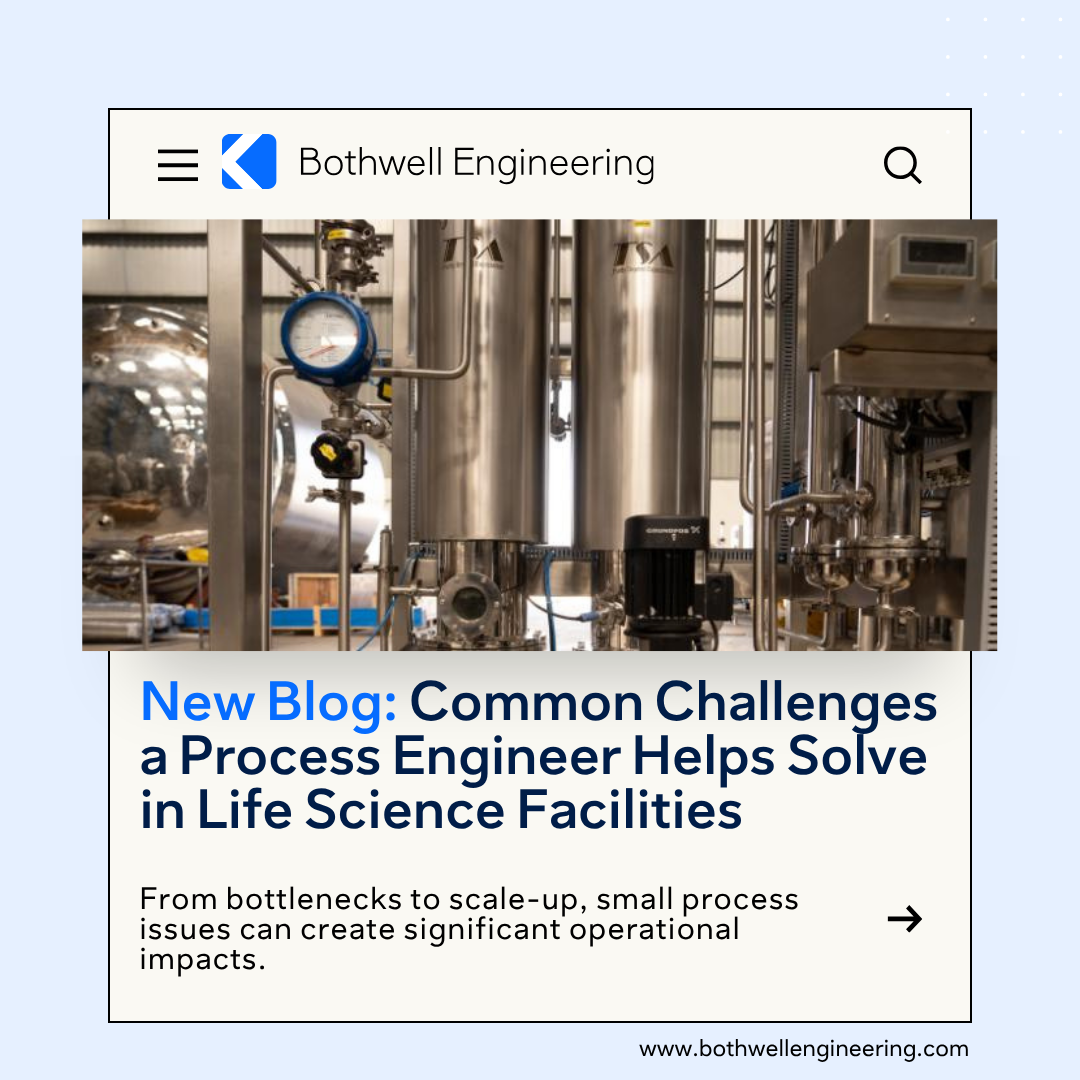
Common Problems a Process Engineer Helps Solve
Life science facilities are complex environments. Whether supporting research and development, process development, pilot operations, or commercial manufacturing, organizations face challenges that can impact efficiency, quality, safety, and project timelines.
This is where process engineers provide value. They evaluate how systems, equipment, and processes interact, helping organizations identify opportunities for improvement while supporting operational goals and regulatory expectations.
From facility start-up and process optimization to scale-up and technology transfer, process engineers are often called upon to solve some of the most persistent operational challenges facing life science organizations.
Capacity Constraints That Limit Growth
One of the most common challenges organizations face is the need to increase throughput, improve efficiency, or support growing operational demands without compromising quality or compliance.
Finding and Fixing Bottlenecks
A process engineer begins by evaluating the full process flow to identify where constraints are limiting performance. The bottleneck may be a piece of equipment, an inefficient workflow, a lengthy changeover process, or a scheduling issue that impacts utilization.
By identifying the true source of the constraint, organizations can make targeted improvements rather than investing in unnecessary capital projects.
Optimizing Existing Resources
In many cases, additional capacity already exists within the operation. Process engineers often identify opportunities to improve scheduling, streamline workflows, adjust process parameters, or optimize equipment utilization to achieve measurable gains without significant investment.
Quality Issues That Drive Deviations and Rework
In regulated environments, quality issues can result in deviations, rejected batches, investigation findings, production delays, and increased costs. Process engineers help organizations move beyond temporary fixes by identifying and addressing the root causes of process variation.
Root Cause Analysis
When quality concerns arise, it is rarely a single factor causing the issue. Process engineers use structured problem-solving methods to evaluate process conditions, equipment performance, raw material variability, environmental factors, and operating parameters.
By understanding why a problem occurred, teams can implement corrective actions that reduce the likelihood of recurrence.
Process Standardization
Consistency is critical in life science operations. Process engineers help establish repeatable procedures, clearly defined operating ranges, and standardized workflows that reduce variability and support predictable outcomes.
When processes are well-defined and consistently executed, quality becomes more reliable and easier to maintain.
Unplanned Downtime and Reliability Challenges
Unplanned downtime can disrupt operations, delay project schedules, impact production commitments, and create additional strain on facility resources.
Process engineers work alongside operations, maintenance, and reliability teams to improve equipment performance and reduce the frequency and impact of unexpected interruptions.
Common activities may include:
The goal is not simply to restore operations, but to understand why failures occur and implement solutions that improve long-term reliability.
Inefficient Use of Resources
Not all inefficiencies are visible on the facility floor. Process engineers evaluate how resources are utilized across an operation and identify opportunities to improve overall performance.
Improving Process Efficiency
Small inefficiencies can have a significant cumulative impact over time. Process engineers assess workflows, process parameters, and system interactions to identify opportunities that improve throughput while maintaining quality and compliance.
Yield Improvement
Whether in development, pilot, or manufacturing environments, maximizing process yield is an important objective. Process engineers analyze where losses occur and work to reduce inefficiencies that impact overall process performance.
Even modest improvements can result in meaningful gains in productivity, cost efficiency, and operational effectiveness.
Safety and Compliance Gaps
In life science facilities, process improvements must be evaluated through both operational and compliance lenses.
Process engineers support risk assessments, process hazard analyses, change management activities, and operational readiness initiatives to help ensure that modifications are implemented safely and effectively.
By bringing a structured approach to evaluating risk, they help organizations improve performance while maintaining alignment with regulatory and quality expectations.
Scale-Up, Technology Transfer, and Facility Growth
Process engineers play an important role when organizations move from development to commercialization, introduce new technologies, expand facilities, or integrate new equipment.
What works successfully in a laboratory or pilot environment often requires careful evaluation before being implemented at larger scale. Process engineers help teams understand these challenges, identify potential risks, and develop practical solutions that support successful execution.
By collaborating with engineering, operations, quality, validation, and project teams, they help ensure processes perform as intended while supporting efficiency, compliance, and long-term operational success.
Partner with a Process Engineering Team That Understands Life Sciences
At Bothwell Engineering, our process engineers support life science organizations across research, development, operational readiness, and manufacturing environments. Whether improving existing processes, supporting facility expansions, integrating new technologies, or preparing operations for future growth, we help clients navigate complex challenges with practical, experience-driven solutions.
From facility start-up and commissioning through process optimization and commercial operations, our team provides the technical expertise and industry knowledge needed to help life science facilities operate safely, efficiently, and effectively.
Contact Bothwell Engineering to learn how our process engineering team can support your next project.

